
Introduction
Welcome to KJK Legal’s October Newsletter and Case Update. This is where we aim to keep you up to date with developments in the law affecting workplaces, as well as what has been happening here at KJK Legal.
In this edition, you can expect to read about:
Celebrating 15 years of KJK Legal;
Staff retirements and new recruits;
Our Adelaide Rally sponsorship;
Closing the Loop SISA Conference;
2026 SARTA Conference;
The South Australian State Wage Case; and
Recent cases from the South Australian Employment Tribunal (SAET).
Firm News
KJK Turns 15
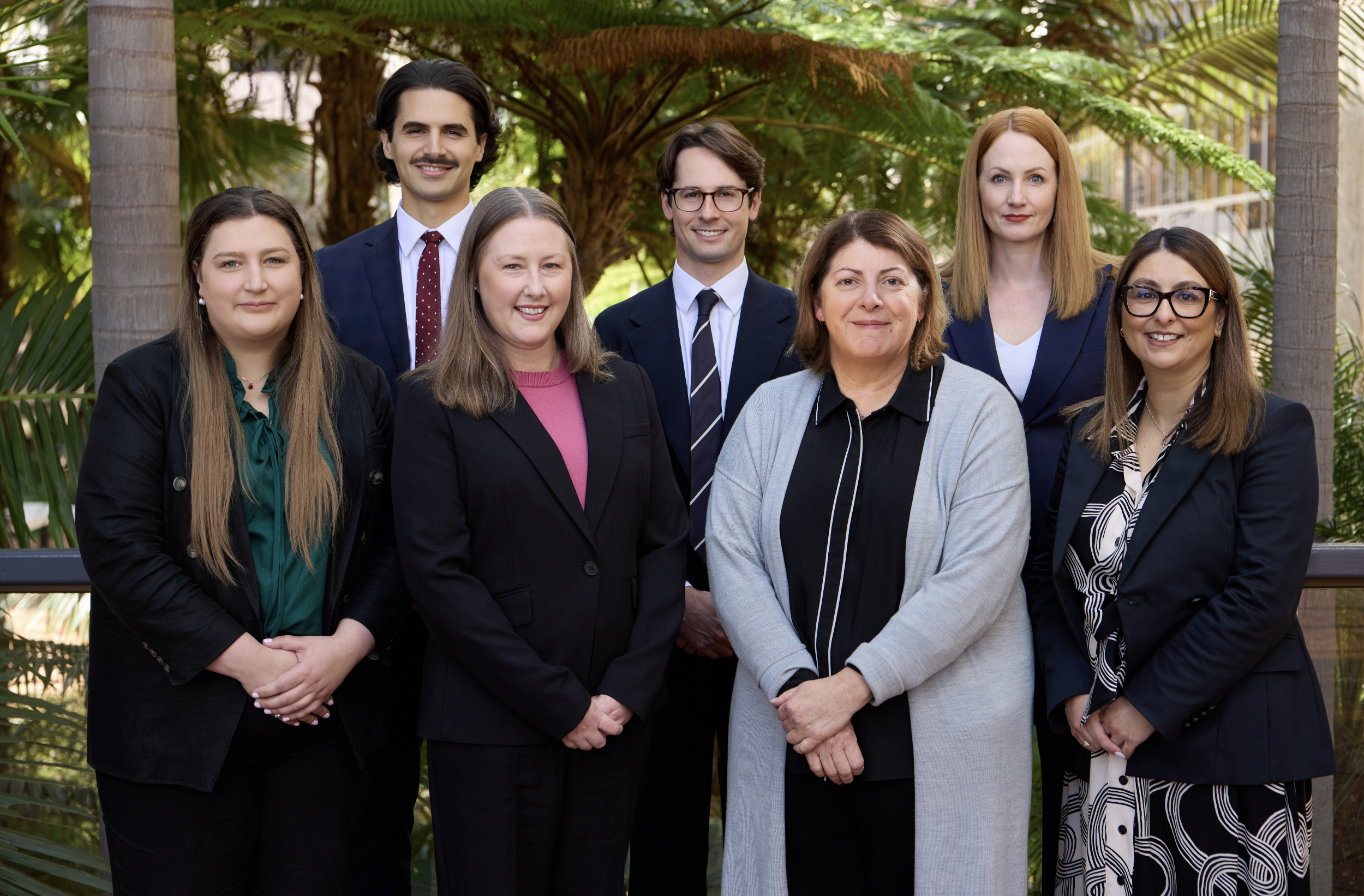
This October, we are delighted to celebrate 15 years of KJK Legal. Founded in 2011 by Managing Director Tracey Kerrigan with Neville John and Mark Keam, the firm began with a strong focus on workers’ compensation and a commitment to providing practical, trusted advice to employers.
Over the past decade and a half, KJK Legal has grown into a nationally recognised workplace law practice, expanding its expertise across employment relations, work health and safety, insurance and dust disease litigation, self-insurance, and heavy vehicle regulatory compliance.
While much has changed since our doors first opened, our values and dedication to achieving the best possible outcomes for our clients remain our focus. We are incredibly proud of how far the firm has come and grateful to our clients, colleagues and friends who have been part of the journey—we look forward to the next chapter.
Website Update
Alongside turning 15, we have made a few changes to our brand! Our new logo has had a simple adjustment, and our website looks brand new, with updated photos and profiles of the lawyers on our team. Even Sunny (Tracey Kerrigan’s new puppy, is taking on the KJK blue in true fashion (pictured below). Go check it out for yourself!

Say hello to Sunny!
Sunny is already making a memorable impression as a much-loved member of the KJK Legal team.
Staff Retirements and New Recruits
After being a valued member of KJK Legal since December 2021, our wonderful Finance Officer, Fiona, has retired and is looking forward to many travel adventures. We are sincerely grateful for her dedication and contribution to the firm and wish her every happiness in this exciting new chapter.
We are also delighted to welcome Michelle as our new Finance Officer. We are very pleased to have her join KJK Legal and look forward to the experience and contribution she will bring to the firm.
Since our last newsletter, we have also welcomed Victor Bergamin to KJK Legal as a Junior Solicitor. Drawing on his experience at the South Australian Employment Tribunal, Victor brings valuable insight into the Tribunal and continues to develop his skills and make a strong contribution to the team.
Adelaide Rally
KJK Legal is proud to sponsor our Special Counsel, Claire Eagle, alongside her partner Ben Clarke of BCM Motorsport, as they take part in the upcoming 2026 Shannons Adelaide Rally, running from 16 to 18 October.
The three-day tarmac rally brings an impressive field of cars to Adelaide and through the scenic Adelaide Hills and surrounding regions. We are delighted to support Claire in this exciting event!

We’re pleased to support Claire beyond her work at KJK Legal and to congratulate her and Ben on being part of this year’s event.
Closing the Loop
We were delighted to sponsor this year's Closing the Loop SISA Conference and to be part of such a successful event. It was great catching up with colleagues, clients and industry peers, and we hope many of you had the chance to visit us at the KJK booth.
The conference featured a number of engaging and insightful speakers, with plenty of practical takeaways and inspiring discussions. Thank you to the organisers and everyone who stopped by to chat with us.
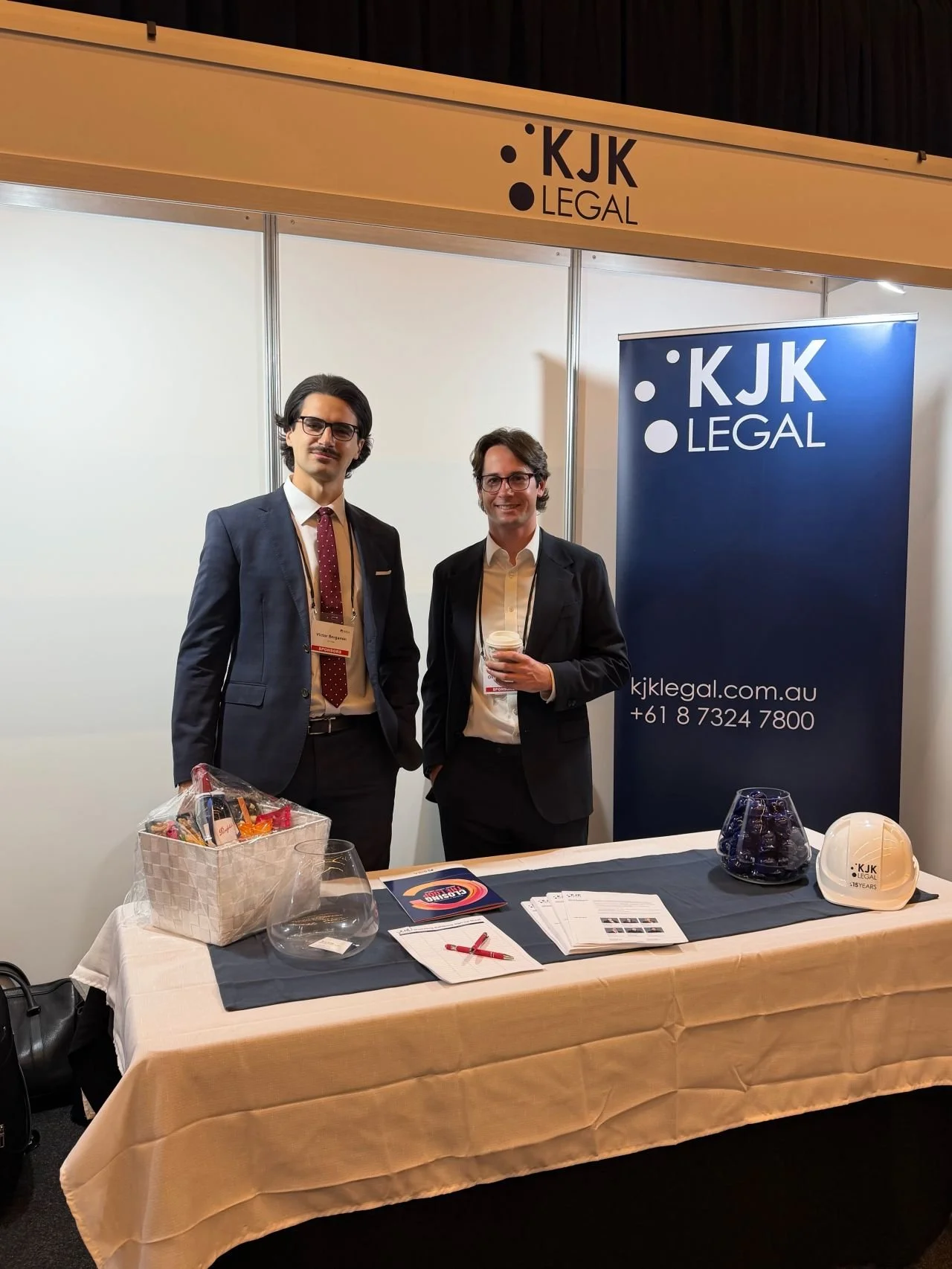
Ollie Fragnito and Victor Bergamin (pictured) attended the conference, taking the opportunity to connect with industry colleagues and engage in discussions around the issues and challenges shaping the sector.
SARTA Conference
KJK Legal is pleased to be supporting the 2026 SARTA Conference, bringing together South Australian road transport industry leaders to discuss emerging issues across safety, compliance and workplace health.
The program covers topics including HVNL reforms, risk management and accreditation, fitness for work and psychosocial wellbeing, and managing incidents and their aftermath. These issues remain particularly relevant for employers navigating their WHS and workers’ compensation obligations in the transport sector.
State Wage Case
State Wage Case 2026 (No 2) [2026] SAET 121 (21 September 2026).
The South Australian Employment Tribunal has handed down its decision in State Wage Case 2026 (No 2) [2026] SAET 121, increasing the South Australian minimum wage by 6%.
From the first full pay period on or after 1 July 2026, the minimum wage for an adult employee is now $1,023 per week ($26.92 per hour), with the minimum casual rate increasing to $33.65 per hour.
The increase follows the Fair Work Commission’s 6% increase to the National Minimum Wage. The Tribunal has maintained South Australia’s separate minimum wage standard, which remains above the national minimum.
What does this mean for employers?
Employers covered by the South Australian industrial relations system should review applicable State awards, classifications and rates of pay to ensure employees are receiving at least the new minimum rates.
Importantly, the 6% increase does not mean every employee covered by a State award is automatically entitled to a 6% pay increase. The applicable award and classification should be checked to determine the correct rate.
Case Summaries
Burns v City of Marion [2026] SAET 125
Topic: Section 18 application
Commentator: Tracey Kerrigan
Background
The applicant suffered injury in the course of employment on 9 May 2022.
He was employed as a Team Member in the Council’s civil works section.
On 11 June 2024 his solicitors wrote to his employment requesting that suitable employment consistent with Section 18(1) be provided to him. A range of potential roles or part of roles were identified.
The applicant’s physical restrictions were significant including no lifting more than 10 kg, no repetitive bending, must change posture hourly. The duties also had to accommodate the applicant continuing and completing a Certificate III in Business Administration.
The respondent asserted that the applicant’s ongoing incapacity for work rendered him unfit for both his pre-injury role and any other form of employment that council may be able to provide.
There were significant factual differences between the applicant and Council about the level of restrictions that applied, the applicant’s capacity for work and his ability to undertake the Certificate III course and undertake administrative duties.
There was evidence that the return to work process had been problematic and that there were performance issues and conflict with staff members, both before and after his injury.
Issues
What version of Section 18 applied, giving amendments to the Act in 2024?
Was it reasonably practicable for the Council to provide suitable employment?
If yes, what suitable employment should be provided.
Decision
The Tribunal dismissed the application. The Judge found the applicant to not be a credible witness in many respects and generally found the Council witnesses to be more reliable and consistent.
The applicant did himself no favours by reason of his behaviours at work over several years, including during the return to work process.
The applicant did not have the physical capacity to be meaningfully employed in an outside existing position of employment. He also lacked the skills and experience to be immediately integrated into a substantive administrative position. The respondent had appropriately investigated what skills would be required to do that type of work but had not been able to complete the course identified.
Some modified duties that had been provided were not suitable employment for the purposes of section 18.
The applicant had not demonstrated the level of skill required for employment as an administrative officer.
The judge ultimately did not need to decide what version of section 18 applied due to the dismissal of the application in any event.
The Judge also noted that A worker in a notice to an employer should identify a position of employment that is contended to be suitable employment. That is either to be by reference to an existing position of employment that may be clearly understood by the relevant employer or if the case is that a position of employment is to be created then the proposed position of employment should be clearly identified by job description. A failure to do so may render an application for an order for suitable employment liable to be struck out or the proceeding dismissed….
Key Takeaways
Applicants for suitable employment should identify a job role that exists and not simply provide a list of duties or parts of roles that they feel they can perform.
An applicant’s conduct as an employee both in terms of their employment generally and post the work injury are relevant issues to consider.
Trying to prove an unrealistic case (eg asserting still being suitable to do an outside role) will generally not be acceptable. Applicants need to be realistic in their assertions as to the duties they can perform.
Responding to a section 18 application can require considerable effort on the part of the respondent.
May v Return to Work Corporation of South Australia [2026] SAET 79
Topic: Costs – entitlement where applicant is unsuccessful
Commentator: Tracey Kerrigan
Background
The applicant sought costs of the SAET proceedings following trial. The applicant had unsuccessfully tried to have the rejection of her claim set aside.
The applicant had been found to have given untruthful evidence in relation to key issues.
The SAET found there was no evidence to support a claim for one incident but there was evidence of a second incident that caused a different injury.
She sought 70% of her costs. RTWSA opposed any award of costs being made.
The applicant asserted that this was a matter where she had honestly but mistakenly convinced herself that her account of events were correct and that she had not in fact “lied”.
The respondent asserted that the applicant was an unreliable and unsatisfactory witness who appeared to invent answers, claimed medical records were unreliable and had been tampered with and made assertions that were untrue.
Issues
Whether the applicant was entitled to any award of costs?
Should the Judge depart from the usual provisions that award costs to an unsuccessful litigant?
Decision
The Tribunal found that the applicant had acted unreasonably when bringing the proceedings in respect to the first alleged injury. The applicant had steadfastly insisted on an untrue version of events which was due to “wilful stubbornness”.
The issue of costs in respect to the separate and second incident had to be dealt with separately.
The Tribunal awarded the applicant 20% of her reasonable party/party costs for work up to the date that the employer commenced its case. She was also awarded the same percentage of her costs for the argument on costs itself.
Key Takeaways
Although workers not receiving an award of costs is rare, this case does reiterate the previous cases where a worker giving untruthful evidence and maintaining a particular position in the face of other objective facts can give rise to at the very least a reduction in their entitlement to costs, if not being awarded any costs at all.
Michael Loader v Return to Work Corporation of South Australia & Recycling Plastics Australia Pty Ltd [2026] SAET 45
Commentator: Claire Eagle
Background
Mr Loader was a convicted double murderer who served 22 years in prison for his crimes. When he was released from prison, he was employed by Recycling Plastics Australia (RPA). He gave evidence that he had found the Lord and turned his life around. There was evidence adduced about his pre-existing knee injuries as detailed in the prison medical records. There was clear evidence of prior injuries, previous surgery, degenerative changes and osteoarthritis.
Mr Michael Loader was employed as a forklift operator. In November 2023, he worked a lengthy shift of approximately 12 hours during which he was required to repeatedly get on and off a forklift. Mr Loader estimated that he did so approximately 200 times during the shift. This was disputed by the employer but ultimately accepted by His Honour Deputy President Judge Rossi. The worker did not give evidence of a trauma but rather general soreness at the end of his shift although he was able to return to his home via a scooter. He said that by the following morning, he was experiencing significant pain and swelling in his right knee. He claimed that his symptoms subsequently deteriorated to the point that he had difficulty bending the knee and was unable to continue performing his normal duties.
RPA and the Return to Work Corporation argued that the worker’s employment was a significant contributing cause of his condition given the significant pre-exiting medical history and symptoms.
Issues
The principal issue before the Tribunal was whether Mr Loader’s right knee injury arose from his employment and, in particular, whether his employment was a significant contributing cause of the injury for the purposes of the Return to Work Act 2014 (SA).
The case also required the Tribunal to consider the significance of Mr Loader’s pre-existing knee condition and the competing evidence concerning his account of the circumstances in which his symptoms developed.
The argument was largely to do with whether the worker’s employment was a cause of his injury.
There was a peripheral issue as to whether there had been a breach of mutuality after the worker moved to NSW to be with his mother after his employment was terminated.
Held
Judge Rossi found in favour of Mr Loader.
The worker’s credibility was challenged given his prior criminal convictions for the murder of two men.
The Tribunal ultimately accepted that the work performed during the lengthy shift, particularly in relation to getting on and off the forklift repeatedly was at least a significant contributing cause of the worker’s right knee injury. The conclusion of Judge Rossi was based on the evidence of medical experts who supported the proposition that the employment had exacerbated his pre-existing, age related osteoarthritis. The existence of substantial pre-existing pathology did not, therefore, prevent the work-related aggravation from constituting a compensable injury in this case. The Tribunal ordered that Mr Loader was entitled to weekly compensation payments and payment of his medical expenses arising from the compensable injury despite him having moved to NSW to care for his aging mother.
If or how the compensation has been disseminated to the worker is not clear because RPA have appealed the decision and have gone into voluntary administration since Judge Rossi’s findings.
Key Takeaway
Loader is a useful authority for claims involving gradual onset injuries, aggravation of degenerative conditions and pre-existing pathology. It reinforces that the absence of a traumatic workplace incident should not be considered as an indication that an injury is not likely to be compensable. Exacerbation is clearly compensable.
For employers and claims agents, the decision highlights the importance of obtaining evidence about the actual physical demands of the worker’s duties, including the frequency, duration and repetition of particular movements, rather than focusing solely on whether there was a specific accident. The critical question remains whether employment made a requisite significant contribution to the injury.
Get in touch
As always, should you have any questions, queries, feedback or comment on anything we’ve discussed above, or advice on any workplace legal needs, then please don’t hesitate to reach out to one of us. If you wish to undertake further reading in relation to any of the decisions discussed, they can be found at www.austlii.edu.au.
